"... the Holy Ghost witnesseth in every city..." - Acts 20:23
he first
time it happened it was in the classroom.I was pickin’ trash up off the floor after all the students had left at
the end of the day.For no
particular reason I happened to turn a scrap of magazine over in my hand before
droppin’ it into the garbage can an’ low and behold what do you figger I
saw?Yup.Jesus.
I don’t know
how it got there.Probably some
student used the cut-out on his or her presentation board and it flaked off and
got left on my classroom floor.But there it was in my hand, a ragged scrap of paper with a photographic-image
of Jesus hanging on the cross printed on it in brilliant grayscale.I stood there for a long moment, my
hand poised over the trashcan.Then I realized I just couldn’t do it.I just couldn’t throw Jesus in the trash.Not even a scrappy magazine cutting of
Jesus.
Above the
dry-erase board in my classroom there were some clips so I reached up and
slipped Jesus into one of the clips.And there he stayed for some time.I’m not quite certain when he disappeared (probably during interim
cleaning or some such occasion) but it wasn’t before students on numerous
occasions made audible inferences about me and my spiritual positioning based
soley on the Jesus cut out hanging there.
Before Jesus
disappeared from the dry-erase board clip, however, there was another
incident.This time it was behind
the Atomic Cycles bicycle shop in Van Nuys.I had ridden in to participate in the Tuesday Night BMX
cruise the shop’s owner, Paul, coordinates.We all waited in the parking lot behind the shop while Paul
closed up and lo and behold what do you suppose transpired?
Let me tell
you.As I was loitering in the
parking lot, its disintegrating asphalt layers broken by weed-choked cracks, I
noticed a reflective flash from amongst the blades of green.I leaned over and withdrew a tiny
object from the crack’s resident clump and found myself in possession of a tiny
redwood necklace-style cross adorned with a simple metal frame.Now, I’m not much for simple crucifixes,
bein’ leary of Tamus an’ all that, and I was ready to toss the jewelry back
down into its parking lot hiding place but then a notable event happened.I rolled the cross between my thumb and
forefinger and, as the charm rotated, guess what was revealed to me that was adorning
the side that had been hidden from me?Yup.Jesus.
There he
was, in extreme miniature, cast out of some shiny metal, arms outstretched
across the tiny cross I had picked up from the parking lot.Again I stood there for a long moment,
my hand poised to flick the object back into the weeds pressing upwards from
the cracked parking lot.But I
just couldn’t do it.I couldn’t
toss Jesus away like that.The
other BMXers chided me when I told them what was going on, of course, but I
slipped Jesus into my bicycle bag and carried him there until that bag was lost
years later.
However, my
story ain’t finished.Jesus showed
up yet again.One day some
students in my classroom, boys, were attempting to operate a below the radar
ruckus but their stifled giggling and frantic gestures between one another
quickly brought down my wrath.I
saw they were passing a piece of paper between each other, placing it back and
forth on one another’s desks where the recipient would quickly attempt to bestow
it upon another participant in the fracas.I confiscated the missive without breaking teaching stride,
much to their curious glee I noted, and when I looked into my hand to determine
what I had picked up, guess what I saw?Yup.Jesus.
The young fellers
had been passin’ back a forth a Catholic prayer card.You know, one of them Jesus, the Divine Mercy “Jesus I Trust
in You” type cards.And there on
the card, in full brilliant color, were Jesus descendin’ from the clouds, his
heart shootin’ forth them beams of spiritual illumination.The boys had obviously been passin’ it
back-and-forth because none of them were comfortable hangin’ onto it but none
of them had the nerve to dispose of it in some way either.And so it came to be in my
possession.And I don’t have a
very good track record with these things as you’ve probably noted.
The culprits
eyed me with humorous anticipation, obviously waitin’ to see what I would do
with the object that they themselves had been hard pressed to deal with in what
felt to them an appropriate manner.And again I stood there, this time with the Jesus card in my hand,
considering what to do with it myself.
Finally, I
looked up at them and rolled my eyes, sayin’, “Sorry, gentlemen, but I just
can’t throw away Jesus” and I slipped the card into my breast pocket and
continued with class.
Driving home
that day I found that card in my pocket and, for lack of any better solution, I
slipped it into the molding on the dashboard of my car.Where it still sits, Jesus eyeing me
speculatively every time I drive, his hand raised in holy gesture and the
Heavenly beams of comfort shining forth from his heart.
And the
moral to this story is that “you never know what it is you’re going to pick
up.”
Okay,
okay.It’s probably more something
along the lines of “when Jesus is trying to get yer attention, it’s
unmistakable.”
What makes a
man leave bed and board and turn his back on home?
Ride away…
ride away… ride away…
-Stan
Jones
John Ford,
as director of the 1956 film adaptation of Alan Le May’s book The Searchers (published serially in
1954 as The Avenging Texans),
maintains the western formula he himself established with Stagecoach in 1939.But operating on a deeper level is a careful balance between upholding
the main character as the monumental hero the story demands while denouncing
the ideology that drives his actions.This balance is achieved by Ford’s manipulation of audience point of
view at crucial moments.
Michael
Wood, in his book America in the Movies,
suggests that Hollywood may often have set out with every intention of
providing a text in social history but came up with snappy entertainment at
best.He calls it a “veritable
school of evasion,” a way for Hollywood to play it safe on almost any issue:
“why drive off customers by treading on their prejudices?”The “problems” addressed in films are
actually an “intrepid indictment of a situation about which there would already
have seemed to be some consensus.” (Wood, pp. 126-127)
George
Bluestone makes similar observations in Novels
Into Film.His discussion
concerning the film code and strictures of acceptability (restraints affecting
Hollywood production long after a standardized system) suggests suppression of
artistic and social vision by audience demands. (Bluestone, pp. 34-43)
It is
tempting, then, to view The Searchers
as a film handicapped by this presentation funny-business because, at first, it
appears that the film is carefully constructed to protect and shield the
audience from its controversial content.A good example is the combination of the opening and closing sequences,
the most audience orienting scenes in the whole film.
The opening
moments present a sort of glass through which the rest of the film is to be
viewed and the end scene reinforces that original vision.By using the camera to give the
audience a specific vantage point of the situation, and aligning a specific
ideology with that vantage point, the audience will take up that ideology and
view events in that specific manner.In this case the audience begins and ends its journey in a settler home,
the abode of right, the residence of wholesome, traditional values.
In the
opening scene, the audience ventures out of the safety of this homely archetype
where they meet Ethan Edwards, a character of questionable ethics.He is a decorated war veteran of the
Confederacy, an Indian skeptic, and quite possible a criminal.He is also a product of the outside
world: a dangerous, unrighteous place.
In the final
scene the audience recedes into the Jorgensen house, again the abode of what is
right.John Wayne, however, even
in his position as redeemed hero, is not allowed to assimilate.He is not permitted to enter into the
viewer’s space.When our harrowing
experiences at his side should be resolved, Ethan Edwards is kept as far from
us as possible.
According to
Wood, it could be said that the film never really asks the audience to question
where their loyalties lie.As a
viewer, once begins and ends inside the innocence of a settler home, the side
of right.That which is
questionable appears firmly locked out, untouchable, impermissible.The film seems to avoid addressing its
controversial content by orienting the audience on the “right” so that it will
not be required to confront the possibility that its loyalties might very well
be sympathetic to the “wrong” ideology.
However, in
accepting such a shallow interpretation an injustice is done to such a
texturally rich film.Upon closer
examination, The Searchers yields up
much to defend itself against accusation of insufficiently addressing its
issues.It reveals itself as a
complex and thought provoking endeavor and acts as a scathing denunciation of
its main character’s driving ideology.Its premise is indeed commentary on the complex isolation and bitterness
in the character of Ethan Edwards.We cannot discard The Searchers
as a film handicapped by the prejudices of its times.It is laden with perpetual meaning carefully woven into its
rich tapestry.
About
halfway through Alan Le May’s book there is a description of the Southwest as a
“never-never country of song and illicit love, with a streak of wicked bloody
murder interestingly hidden just under a surface of ease and manana.”
The words
are those of Amos Edwards, the Ethan Edwards of the written page.His descriptive poetry is a little
contrived when historical reality is held up for comparison but it is a fairly
accurate description of the fictional tale itself.The book, as does the film, centers around the consuming
nature of retribution, how it destroys everything involved, including those who
perpetuate it.
Ford’s
Southwest, as in Le May’s book, is sweeping pastels and adobe, indifferent to
the delicate balance of civilization and savagery within its bounds.Ford continually challenges us with
this savagery.From the moment the
audience leaves the Edwards home in the opening sequence, Ethan’s quest reveals
the delicate balance of savagery within the man himself.
Even so, it
is the changes between the film and book that reveal the depth of Ford’s
adaptation.Some differences
include changing the Mathisons into the immigrant settler Jorgensens and making
Martin Pauley 1/8 Cherokee.However, probably the most prominent, and most important, changes are
those made to the Edwards character himself.Le May’s Edwards is not a dedicated Confederate, nor is
there an innuendo of criminality.Most evident is his lack of blind hate for Indians.He seeks vengeance for the death of his
brother’s wife, but his wrath is not distributed over the entire indigenous
population.
When it is
discovered that Le May’s Edwards is far less incendiary than the one portrayed
by John Wayne, suspicion abounds.It leads to speculation that increasing the fiery nature of a tale is no
way to tame it to satisfy audience prejudice.The question arises, then, that if Ford was playing it safe
with controversy, as Michael Wood suggests filmmakers do, why heat it up with
these potentially explosive elements?Unless the intention was indeed to make commentary on an already blazing
situation.
Many times
over the course of the film we are tempted to side with Ethan, the horror of
the situation seeming to render acceptable his desperate measures.Whenever it is in question, though,
Ethan’s ideology is always degraded, loud and clear, for the audience.A good example is when Ethan encounters
the “crazy” white girl refugees at the military encampment.Wayne’s final glare, his steely eyes
peering from the deep shadow cast by his black hat across his soul, is a most
forbidding image.This is not a
man that invites the audience to his side.
Judgment on
Ethan’s character is also accomplished by deriding commentary.In both the buffalo slaughter sequence
and when Ethan makes the decision to kill Deborah, Martin Pauley’s voice
denounces Ethan’s actions.The
stubborn façade Ethan assumes at these moments also alienates the audience.
Careful
examination of audience placement, whether it is how Edwards is portrayed to
them, where they view him from or what other characters say about him, reveals
that the production is a deliberate attack on Ethan Edwards’ convictions.
“Prodigal
brother,” as Ward Bond puts it, is an apt description for Ethan Edwards.He is indeed the hero of the film but
he is a hero with a looming dark side.We can never fully appreciate Edwards’ efforts because of our own
uncertainty about his true nature.Because the ruthlessness that lurks within him almost went too far, we
cannot be sure that he has actually redeemed himself.Even in saving Deborah and returning her to where she will
be cared for, we cannot help but feel that she is safe not just from Indians or
enemies, but from Ethan Edwards himself.
So, the end
sequence becomes a powerful denunciation of what lurks inside Ethan.Even with his heroic actions, the
message to the audience is that he cannot be condoned.Unlike the prodigal son of the Bible,
the prodigal brother cannot be brought back into the fold.If he was shown as the assimilated
hero, forgiven, his past would be submerged and forgotten.But the image the audience retains will
always be that of him standing outside the door of the settler home, exiled as
a judgment for those past actions for which he may never be reconciled.
Something
else noteworthy in Ford’s crafting, however, is that Ethan denies himself entry into the Jorgensen home.While not justifying him, his decision
does give deeper insight into who he may be.It hints at a richness of character that has not been
examined here, and while Ford will not permit us to side with or condone Ethan,
neither are we as an audience permitted to truly judge him.
Perhaps, if
the tears in his eyes at the sight of his brother’s burnt homestead were our
own, we might better understand his words: “I don’t need you for what I’ve got
to do…”It is this final amount of
self-realization for Ethan, that he cannot be part of the audience’s world,
that Ford leaves us with, and perhaps the director’s greatest accomplishment in
The Searchers is putting the audience
in a position to receive an unsettling glimpse of “what makes a man to wander.”
Works Cited
Bluestone,
George. Novels Into Film. Berkeley
and Los Angeles: University of California Press,
1957. Print.
Le May,
Alan. The Searchers. New York: Harper
and Brothers, 1954. Print.
McDougal,
Stuart Y. Made Into Movies: From
Literature to Film. New York: Harcourt Brace
Jovanovich College Publishers, 1985. Print.
The Searchers. Dir. John Ford. Warner
Brothers, 1956. Film.
Wood,
Michael. America in the Movies. New
York: Dell Publishing, 1975. Print.
Anachronism is in.Men (and women) are sportin’ waxed-up moustaches.Craft libation makin’ is all the
rage.Midnight cyclists fantasize
their neon fixed-gear bicycles earning them a spot in the lineage of daring
penny-farthing riders from days of yore.
Anachronism has also been makin’ inroads in popular music as
of late (again).There are banjos
on mainstream radio.The
bluegrass/hip-hop alchemy of Justified’s
theme song has been nominated for an Emmy.Baz Luhrmann’s revisioning of Fitzgerald’s The Great Gatsby foxtrots to Andre 3000.
The nature of anachronism, however, is just that.It’s anachronistic.There’s always the omnipresent reminder
that an out-of-time cultural reference is being made.This isn’t a bad thing.Anachronism exists for a reason.But it’s also important to remember that interest in the
“real thing” has also survived the test of time, and with Southern California’s
Jug or Nots’ self-titled first release, that’s exactly what you are
getting.The real thing.
The Jug or Nots play traditional American street music from
the 1920s and 1930s, and they do it all acoustic with bonafide traditional
instruments including cigar box guitar, kazoo, washboard, and various kitchen
utensils.They perform as an
ensemble on street corners, farmers markets, harvest festivals, tiny juke joint
stages, and from the flatbed of parading hay wagons.And when you see (and hear) them perform, you’re hard
pressed to shake the feeling that perhaps you’ve momentarily slipped through a
warp of some kind and are witnessing contemporaries of Cannon’s Jug Stompers or
the Mississippi Shieks.There’s no
Twilight Zone here, though, folks.The Jug or Nots are the real thing… and that’s just what they set out to
deliver with their first studio recording: the Real Thing.Good news.They succeeded.
The Jugs’ initial recording offering is a collection of
traditional and original tunes committed to posterity with the utmost care in
preserving the “accurate” feel and sound the band works so hard to evoke with
their live performances.There is
no anachronism here.These gents
determined to provide us with a set of songs that truly sound like they are
from an earlier, simpler time, and that’s exactly what the listener comes away
with.If you like your jug music
to actually sound like it was made in a time when jug music was king, this is
the recording (and band) for you.Their rendition of the “Spider-Man” theme will have you doubting your
own cache of pop culture knowledge.They make it sound like such a tried and true jug band tune that you’ll
be googling the superhero’s history to assure yourself that you haven’t been
wrong in your assumptions all this time and that Spider-Man is not actually a
1930s contribution to the comic world.
Don’t give up on anachronism, but don't mistake the Jug or Nots for such. If you have a soft spot for a contemporary band that can
transport you wholly into a bygone era, causing you to momentarily forget that the recording you are listening
to is not actually 80 years old,
then the Jug or Nots (and their CD) are
the band for you.They are
traditional, heartfelt, bawdy, and very talented at the niche they are carving
out for themselves.Try them.They’ll have you believin’ that “the
sales tax is on it” is a brand new contention for regular fellers everywhere.
This here commentary is wholly unsolicited, an' far past the oven timer of immediacy (not, however, past the oven timer of relevancy), but I got some things to say...
Journey to the Far Side of the Room by Kindom Of Not
In the only-could-be-original realm caught somewhere between
the medieval folk rock pageantry of Donovan and the sonic voodoo rituals of
Screamin’ Jay Hawkins there is a new kingdom to contend with.The Kingdom of Not.
Three years ago I sheepishly inquired of Andrew Goldfarb,
The Slow Poisoner, if’n he’d be interested in playing GRIT’s first Old Timey
Music and Variety Show.Completely
surprising me, he responded by asking if, in addition to his
snake-oile-salesman-one-man-band routine, we would be interested in the new
project he was involved in (then called The Wounded Stag).He forwarded some videos of their work
and we were completely sold.
While certainly musical in orientation, the project Goldfarb
and frontman Dan Carbone brought south with them is best perceived through the
filter of performance art.Backed
by a turbaned and masked Slow Poisoner grinding out his pulsating
jungle-folk-psychedelia, Carbone (channeling Buddd Underwood) sings, chants, admonishes,
pontificates, and acts out a wide array of fringe characters, fluidly donning
costumes, toys, and various other props drawn from the guts of a massive steamer
trunk at his feet.
At once both fascinating and alarming, the duo’s performance
danced a taut tightrope between luring their audience in close and then
abruptly provoking a terrified desire to flee for fear of the cataclysmic
happening being conjured.It was
definitely spectacle, definitely a spiritual journey of some sort, and it was
definitely enlightening, but it did not leave the audience soothed or reassured
about its uncertain place in the vast and scrutinizing (or indifferent) cosmos…
and that unwillingness to answer its own questions made the performance truly
magnificent.
I have to admit that I was a bit dubious when I heard that
Carbone and Goldfarb were going to commit their project to aural recording.I didn’t know how the living, breathing
beast I had witnessed, its name now changed to Kingdom of Not, would translate
into an audio only format.Even
so, when the disc came in the mail I fell upon it with eager anticipation.That anticipation was not disappointed.
While Kingdom of Not’s recording, titled Journey to the Far Side of the Room, is
certainly a different creature than the live performance, Carbone and Goldfarb
have definitely accomplished a masterful act in bringing the concept of their
live Prometheus to the listening-only audience.It is not a substitute for experiencing their live
performance, but as a detailed conceptual narrative it is undeniably its own
very important monster.Its often
modal musical drivings, trance inducing at times, possessed of a frenetic
energy at others, combined with the sometimes-storyteller-sometimes-eyewitness
bard work of Buddd Underwood create a richly decorated otherly world that
effectually commands the mind’s eye for the duration of the production.Not an easy feat when working with such
an elaborate aural-oral-visual foundation, but a feat admirably accomplished.
There indeed exists a Kingdom of Not.Its domain, however, extends
considerably beyond the realms capable of being rendered by the recording
studio.That said, if the kingdom
could be transferred to a listening-only format, Carbone and Goldfarb have committed
to us the best possible manifestation imaginable.Listen to and embark upon the Journey to the Far Side of the Room, but do so knowing that you
will not be able to cease your pilgrimage at the edge of the compact disc.The kingdom will continue to beckon
from beyond the confines of the recording.Acknowledge and follow.
Okay... I done owed this one since August of 2012. Sometimes better late than never may not be applicable, but I can always keep my fingers crossed, eh?
Stars Pulled Down by Unextraordinary Gentlemen
Unextraordinary Gentlemen have been sketching out their
particular vision of another time and place fantastic and anachronistic for
some time now.Two EPs, 5 Tales From God Only Knows and No Hands to Guide Us, have collected
tales of the desperate, disparate, and debauched.Set to Romanticism soundscapes interpreted in part by the
archaic machineries of an industrial revolution, these two offerings have
familiarized UXG’s listeners with a Victorian Neverwas inhabited by the noble
and the questionable engaged in voyages extraordinaires.A very European parlour type of
Victorian, there has been a strong cane and bussel and top-hattedness to them
that is very properish.But the
new longplay, Stars Pulled Down, has
delved into something, for lack of a better term, very American.This new offering finds Unextraordinary
Gentlemen having emigrated from the Old World to the New, the wild borders of
an indifferent mechanical hinterland whose flesh and bone gears grind
themselves away in struggles with mortality and excess.
As with its predecessors, Stars Pulled Down is a collection of musings chronicling forays
into both the temporal and the fantastical.But while UXG’s previous tales unfolded within cosmopolitan
settings, this stage is a no man’s land of fog shrouded forest hilltops, frontier
towns weathered gray, and sun-scorched peripheries.The struggles the characters undergo are familiar, but the
savagery demanded by these uncivilized locales is that of a brave
new world of ruggedness and rough-hewn independence, more whiskey than absinthe.
The most fascinating aspect of Stars Pulled Down is its musical “folkiness.”There’s a dustiness and
Appalachian-ness to its sound wholly appropriate for its duster-clad pioneer and
outlaw characters, but it is accomplished without the cliché of banjos and
other instruments associated with “old timey.”Instead, a spareness and primitiveness of electronic instrumentation
has been employed to carefully fold the “feeling” of the homegrown, the down
home, into the soundscapes.And
atop these brooding sonic terrains a violin casts strains of the olde world, its
classical refrains coarsened by the “music of the people” that defines this new
unexplored place.
As the listener travels from the Sherman’s March-ishness of
“Elephant Head,” through the dimensional warping voyage of “Almost Imaginary,”
and into the Gothic Americana playground rhyming of “Kiss the Earth” it is very
clear that UXG is moving into new territory.They even offer a traditional protest tune in “Dawn/Worst of
All,” a dirgey account of miners descending into the grave everyday only to
resurrect for a few fleeting hours of unrest before the dawn calls them down
into the earth once more.And if
these tunes are not pointing out clearly enough the direction UXG is edging in,
with “Old No. 9” they present the most venerated of all roots music genres: the
train song.And the ghostly Old
No. 9 is not just any train. It’s the juggernaut of steam and steel that
carries us to the farthest reach of the new domain Unextraordinary Gentlemen is
exploring, the End of the Line.And in these shifting, uncertain sands of mystery lies the leaving point
for “Long Time Gone,” a lament of wanderlust, perhaps the wanderlust that has
brought us to this new borderland in the first place.And what lies beyond?A new frontier?The
gallows?Perhaps simply “The End
Again.”
Been outta practice fer awhile.Work’ll do that to ya.One day ya wake up an’ realize: Hell, work is getting’ in the way of all
the important stuff!
It’s been happenin’ to me.I’ve let all this blogging an’ whatnot slip by in favor of
keepin’ in good with The Man.
Well, first things first.I owe some way outta date music reviews, but even outta date
I still got stuff to say that I want committed to print so I’m gonna go ahead
an’ take care of this business anyways.
Light on in the Hallway by My Half Ridden Dream
The oldest promised musickal commentary I owe is to My Half
Ridden Dream.MHRD is the
sometimes-solo project of one Thomas A. Alfera, and in the hustle an’ bustle of
2012 he released a self-produced longplay called Light on in the Hallway.Late one night many years (possibly decades) past, LA’s Lonesome Cowboy,
Jim Ladd, prefaced a playlist by sayin’ that “the next set of music makes me
wish I was cruisin’ down Pacific Coast Highway in a 1967 Mustang convertible,
the top down, the full moon shinin’ down, the warm summer breeze whipping
by…”I no longer remember what
tunes followed that introduction… one of them may have been “LA Woman”… but
it’s that specific description that the first spin of Light on in the Hallway brought back to me.
All of the songwriting credits of the new offering go to
Alfera and his considerable travels with the American Experience are downright
palpable in the musical an’ lyrical odyssey he shares with the listener.At its heart, Light on in the Hallway is a tale of loves lost and found, in
between, and right where you left them; a poignant spirit-quest into the
eternal paradoxical co-existence of independence and loneliness and the
struggle to find their balance.
The album opens with “Anna Come Home.”It’s a melancholic memoir, but with its
roots-rock forward momentum the tune gives us no option but to press on down
the highway.“Ellen’s Song” and
“D.O.I.” continue a pilgrimage that never leaves us at any one roadside stop
for very long, emphasizing the bittersweet fact that while our emotional
grapplings may never resolve, they do sting less with the distance we can put
between them and ourselves.By the
time we reach “The End of Love” and its fuzzed-out, oozing, rock bottom, the
miles traveled in philosophical introspection have steadied our psyche enough
that we can see around love’s tattered edges.There is possibility up the road, and even though that
possibility may still very well be simply the possibility of disappointment, “Summer
Days,” “Genuine Feeling,” and “Happily Classified” affirm we must be strong
enough to live through that possibility.
Musically, Light on in
the Hallway is possessed of a rich adventure of American sound and vista.Even so, the songwriter is not trapped
in a cliché of the Heartland.His
travels with Americana have taken him across a varied and diverse land and My
Half Ridden Dream’s final formula has been baptized in the waters of Southern
California, that edge of Western Civilization.It looks back at the familiar and forward into the unknown
simultaneously.The narrators’
adventures and influences sparkle, but they have been fashioned into a unique
voice crying in that wilderness of three chords and the truth.A voice well suited to explore that
duality of cynicism and hope that is the “Light on in the Hallway.”
Hopefully you have a 1967 convertible Mustang and access to
Pacific Coast Highway for this one… and if not, close your eyes and let the
music take you there anyway.
You can listen to and possess Light on in the Hallway right here:
“Edible, adj.: Good to eat, and wholesome to digest, as a worm to a toad, a toad to a snake, a snake to a pig, a pig to a man, and a man to a worm.” - Ambrose Bierce
"The belly rules the mind." - Spanish Proverb
"ncle Jello" was the first painting of Nouar's that I ever saw in person.
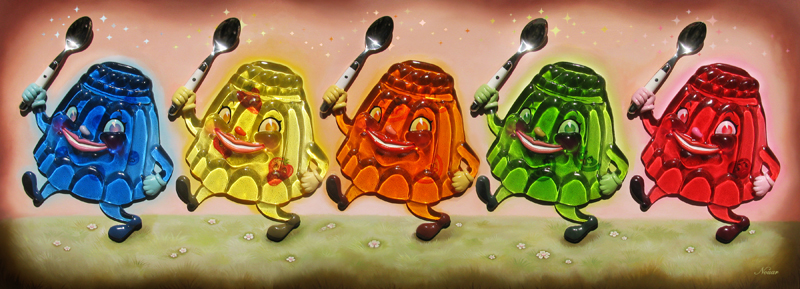
Being the friend of a friend, I had met the artist previously and had acquired some glossy postcards from her; one of the misleadingly innocent “Lemonade Parade” and another of the far more unsettling “You Satisfy Me.”To say that I was intrigued by the images would be an understatement, and I became more enamored with the work after peering into her repertoire via the internet.
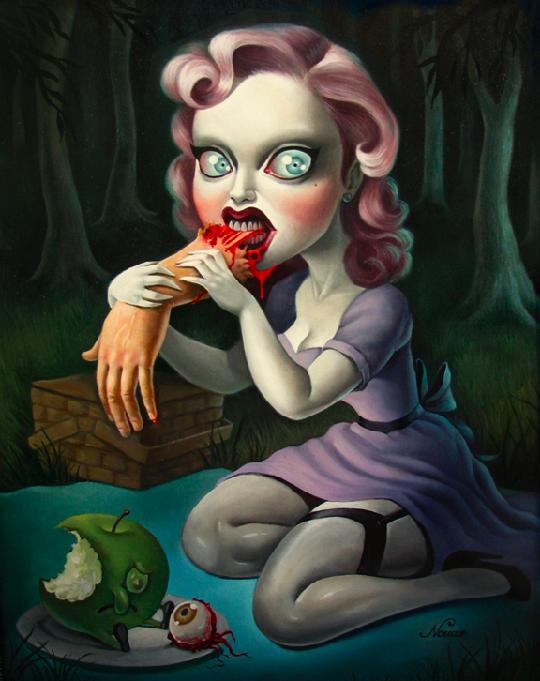
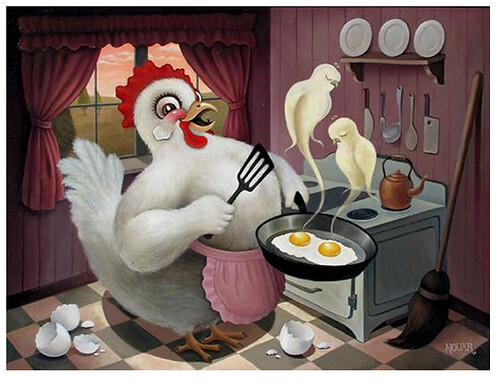
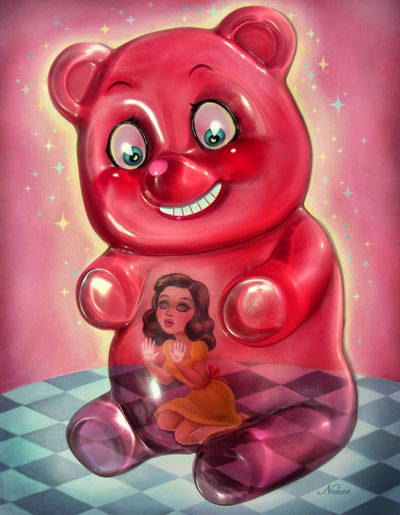
To the casual looker, Nouar’s work is definitely a playful romp through the ideals of mid-century foodstuff marketing, complete with anthropomorphous manifestations of carousing vittles who sing, dance, and lead us to believe that their sole purpose for existing, their utmost desire in life, is to be consumed.With a closer look, however, it becomes apparent that there is much more to scrutinize in Nouar’s carefully thought out images than just a well crafted sense of cartoon-ish nostalgia and kitsch.If you contemplate them even momentarily, the questionable behaviors of Nouar’s characters lead to narratives that transcend the world of food and instead comment on the societal interactions of that most questionable of creatures, the human being.
Food is a brutal contemplation.It is chopped, crushed, squeezed, diced, gutted, butchered, boiled, fried, grilled, chewed, eaten, digested, consumed.It is not a far stretch to say that human beings are also a brutal contemplation… and perhaps not much more of a stretch to say that many of those aforementioned brutalities very literally associated with food can be, at the very least figuratively, associated with human interactions and relationships as well.Under such a light, the theme remains “eat or be eaten”, but the implications become far darker.
But back to the beginning of the story.“Uncle Jello” was the first painting of Nouar’s that I ever saw in person.And what a first-person experience it was.In 2009, the Corey Helford Gallery in Culver City, CA, hosted a group exhibition called the Multi-Plane Show.For the exhibit, a divers group of contemporary artists were invited to create artworks utilizing a vintage multiple-glass panel animation technique.Essentially it involved creating images on three separate sheets of glass which were then assembled into layers, bringing a sense of depth and perspective to the content by utilizing the actual space between the pieces of glass.Most of the artists in the show seemed to take the logical route, using the glass layers to create environmental depth, but “Uncle Jello” was different.Whereas most of the showpieces involved a looking across or through space, Nouar’s contribution instead chose to use the glass panel technique to look INTO a space.Where most of the artworks surrounding it had narratives and actions playing themselves out in familiar, tangible locales, the tale perpetrated by “Uncle Jello” played itself out in some indefinable netherworldly innerspace.
Uncle Jello himself was a red-tinted transparent resin sculpture affixed to a pane of glass.Just head and shoulders, the jello-mold headed gentleman smiled invitingly in his smart bow tie and brown sport coat, a fitting expression for a dashing portrait.But Uncle Jello’s gentlemanly facade became unshakably sinister when it became evident that there were unhappy faced strawberry people trapped within his gelatin noggin.At once both charming and alarming, “Uncle Jello” became so much more than simply a three-deep story about the demise of some strawberries.Who was this belying character?Who were these poor berries suspended like thoughts within his evidently calculating cranium?Why were they there?What had they done?What lay in store for them?Would they ever escape?Could there be an “Uncle Jello” in our own lives?
The piece really was, to say the least, quite remarkable.I had been enraptured by the galleries of her work I had perused online, but this was definitely a case of an artist doing something new, fresh, and unprecedented.If I had not already been a convert to her work, “Uncle Jello” undeniably sealed the commitment.Nouar had found a way to add a dimension, literally, of meaning to an already complex mixture of symbolisms and motifs.And being able to accompany the visual, technical element with narrative and vision that made the work truly meaningful is definitely a feather in her artistic hat… beret?
Luckily, the significance of what the artist had brought to the table was not lost on the owners of the gallery.“Internally Yours”, the Nouar solo exhibit opening at the Corey Helford Gallery on June 11th, will showcase a body of work birthed in the premise of that first “Uncle Jello.”Using transparent food as a metaphor for the struggles, entrapments, and vices of our own lives, the exhibit’s artworks continue to explore Nouar’s already established themes of human interaction and relationship.But experimenting with the new tools afforded her by “Uncle Jello”, Nouar’s new work is taking us on an inward bound journey.It is a poignant exploration of who or what we hide away on the inside, perhaps ultimately asking us to question whether we may be the ones who are in fact being hidden away by something greater than ourselves.A journey we should all be looking forward to taking.
"Internally Yours"
Nouar
Opening Reception - Saturday, June 11, 2011 7-10pm
Corey Helford Gallery
8522 Washington Boulevard
Culver City, CA 90232-7444
(310) 287-2340
"After silence, that which comes nearest to expressing the inexpressible is music." - Aldous Huxley
ayle’s Perks is located at 9028 Balboa Blvd, North HillsCA91325.It’s a tiny mom and pop coffee shop tucked away in the corner of a shopping center centered around an Albertson’s and a Wyler’s Delicatessen.And for several years in the early 21st century it was the hub of burgeoning local musical talent.It featured an open mic night that drew an audience from the surrounding area that was comprised of far more than just would-be singer songwriter musicians entertaining one another.People actually came to Perks to listen to what its open mic attendees were creating.
The names that recurred at Perks are not easily forgotten.Ben Jones, Aaron Miranda, Tom Washington, Bryan Chan, Mike Dill, Brooke Trout, Mark Brainard, Alex Schmauss, John Neira… the list goes on and on.Every one of these artists brought their musical conjurings to Perks every week to share what they had been creating, to get feedback for their efforts, to subtly hone their craft according to the constructive criticisms of their peers and an audience that was always appreciative but certainly discerning.
Many were the late evenings, special cup of Perks’ brew clutched in hand, that audiences of artists and connoisseurs enjoyed the musical performances of open mic attendees.Innumerable were the times that music of the highest order was consumed alongside Perks’ humble Panini and treat offerings…
But, as it seems all good things eventually converge to an end, ASCAP eventually caught up to this neighborhood mom and pop coffee shop that was not paying the appropriate dues to be featuring a weekly night of live music.Unable to address the requested fees on the part of the powers-that-be, the venue collapsed its open mic night and ceased to be a place where artists, musicians, and singer songwriters could share their creations with an appreciative community audience.
Undaunted by the bean-counters, however, the artists who regularly converged on Gayle’s Perks on a weekly basis have moved on to pursue their creations above and beyond the parameters of the beloved open mic night.Nearly every Gayle’s Perks participant has been preoccupied with the generating of musical projects that are completely worthy of note.Brooke Trout has moved on to a finely honed pop-rock project known as The Red Herring, Alex Schmauss has adapted his musical social commentary to the psychedelia of Alex & Alex, Aaron Miranda and Squeezebox Sam (yours truly) have invested their efforts in the neo-Americana Folk Punk sound of GRIT, Mark Brainard has invested his efforts in the rock n rollin’ Full Throttle, and Tom Washington has sculpted his Blue Lightning Review in his new home of Tehachapi, California.
On May 12th, 2011, Stephanie Antonio of Subculture Girl Productions, will give several of these Perks regulars an opportunity to have a reunion at LaBrie’s Lounge in Glendale, California.The “Get Off The Couch Thursday” event that Stephanie has secured will showcase current projects from Brooke Trout, Alex Schmauss, GRIT, guitar virtuoso Richard Marchetta, bluesman Brian Chan, and American rock and roller Tom Washington.This will be the first time all of these artists have been given the opportunity to be in one place at the same time, sharing their unique musical visions, in nearly five years, and this collection of local singer songwriters and music makers is not to be missed.
The facebook invite for this event can be accessed here:
ASCAP tried to turn these artists’ creative environment into a monetary issue and, in light of the mom and pop nature of the venue, they succeeded in robbing them of a place to share their creative endeavors.But all these great music makers have moved on to projects that could never have been were it not for their fellowship at the Gayle’s Perks open mic night.Come out to Subculture Girl Productions’ “Get Off The Couch Thursdays” at LaBrie’s Lounge in Glendale on May 12th to experience what these creative entities have been wrangling into existence in the years since Gayle’s Perks ceased being able to provide a place for them to gather. The doors open at 7:30pm and it's only 5 dollars! What better deal could you get on a Thursday night in Los Angeles for five measly dollars?
And, in the meantime, visit Gayle’s Perks for a cup of coffee or a fantastic Panini.
"I had a front row seat to hear ole Johnny sing." - Shel Silverstein
merican Recordings by Johnny Cash arrived in 1994, produced by Rick Rubin as the first release of his newly renamed record label.I was no stranger to Johnny Cash (I can blame that on my parents and older siblings), but the album did appear at a time when I was finally making music my own and I absorbed it eagerly and wholly.Probably the most important aspect of that record-release was the tour that accompanied it, enabling me to see Cash live at the Hollywood Pantages Theater.I don’t know that there are words to describe the fondness I have for that memory, even though I got a second opportunity to see him live when The Highwaymen toured for their last album a year or so later.But they were both events fated to not repeat themselves and I feel very fortunate to have had the experience.
But, despite it being Johnny Cash’s birthday, it isn’t really The Man In Black I want to lay some accolades on.There are many who will do that today and my voice would only be lost in the shuffle.Who warrants a listen to some accordion-squeezing hack from the San Fernando Valley when every accredited music critic, music historian, and venerable musical personality has something to say on the same topic?Nah.Everyone knows how I feel about Johnny Cash.I will let the masses say their part.Who I want to spend a moment talking about is Beck.
Yeah.Beck.That guy who musically defined the modern era of hipsterdom with classics such as “Loser”, “The New Pollution”, and “Where It’s At.”What the hell does Beck have to do with Johnny Cash?Well, Beck opened for Johnny Cash at that Pantages show so long ago.Even at the time the pairing was unprecedented.I remember friends being surprised when I told them who the opening act was indicated to be on the ticket.Even my eclectically inclined contemporaries were hard pressed to see the connection between Beck’s renowned frenetic, yard-blower stage antics and the perceived hallowedness of Johnny Cash.
My thirteen years senior older brother, a Johnny Cash diehard, reviled the thought of the pairing when I explained to him who Beck was and played some music for him.He even went so far as to suggest that we arrive late enough to the show as to miss the opening act, but my cajoling won out.
Anyone who knows Beck’s live performance (at least in the mid-1990s) reputation should have no problem comprehending my puzzlement over the pairing.But it was a puzzlement that was unwarranted.Instead, it was one of those instances where the Powers-That-Be should have been trusted.
Beck came out alone.Clad in a nondescript western shirt and weathered boots and armed with an undecorated steel bodied guitar he proceeded to render his own versions of what he verbally labeled “bad ass songs” for a hushed, and assuredly surprised (if not awed) audience.Beck’s “bad ass songs” were tunes out of the songbook of Americana, traditional tunes a century old with lyrical content that raised the eyebrows of the listener who believing in the premise that the past was innocent and plagued by fewer societal complications and problems than this supposedly downward-spiraling modern world.Songs about murderers, drug abuse, crushed dreams, and questionable repute from bygone eras flowed from Beck’s pickin’ an’ strummin’ fingers and searching voice.At one point he brought out a dobro player and a snare drummer and did a couple tunes as a trio, and in an inspired moment he blared a ditty through a harmonica fed through the tiniest and scratchiest of amplifiers, stopping to sing verses and chorus accapella before resuming his hearty huffin’ an’ puffin’.
For nigh on 40-some odd minutes Beck continued with this very un-Beckish performance.Then, amidst a tune he was carving out on the steel bodied guitar, a string break loudly resonated through the pick-up and out into the theater’s acoustics.There was a muffled “Shit” under Beck’s breath, then an apology, a regretful farewell, and a thank you to “whoever it was that booked me for this gig.”
And then he was gone.Johnny Cash delivered after that.The man was everything you could have imagined he would be, a stage presence so overpowering and commandeering that there was absolutely no stage show necessary to hold that audience riveted.The reverence held through the opening set with his band, through his just-me-and-my-guitar set in the middle of the show, and through the filmstrip-of-crashing-locomotives-accented Orange Blossom Special encore.
But even coming away from that night with the euphoric “I can’t believe I just saw Johnny Cash” mindset, it was hard to shake Beck.My perception of his music had been changed forever.Odelay! made sense on so many more levels than it had before, and the appropriation of such traditional tunes as “One Kind Favor” into his following album experimentations came as far from surprising.
When I look back on where the inspiration for Squeezebox Sam and any of the musical projects I’ve fooled with birthed from, there are the usual suspects such as being raised in a musically-versed family, permanently borrowing Lomax books from the public library, and hearing Gordon Gano’s “Mercy Seat” side project on a mid-morning independent radio broadcast.But I would be a liar if I did not include that Beck performance in the list.His offbeat stint truly inspired me to look at those beloved antique tunes in new ways.I, too, thank whoever booked him for that “gig.”
- Squeezebox Sam
Here's the variety review link fer that show so long ago:
"File under sacred music." - blurb from The Cramps' Songs the Lord Taught Us album art
y doom was to be minorly eclectic.
There just wasn’t any way I was going to avoid it.I grew up in a house with parents who were fairly music-adept.My mom was 18 years old in 1954.I have a box of original 45s from Sun Records and Chess.Hank Williams multi-disc 45rpm sets.Chuck Berry’s “Deep Feeling”.A deeply grooved Gene Vincent.Even a Cameo of Charlie Gracie’s “Fabulous”.All artifacts from my mother’s youthful musically-inclined ear.
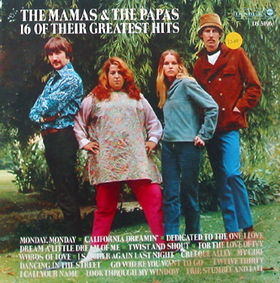
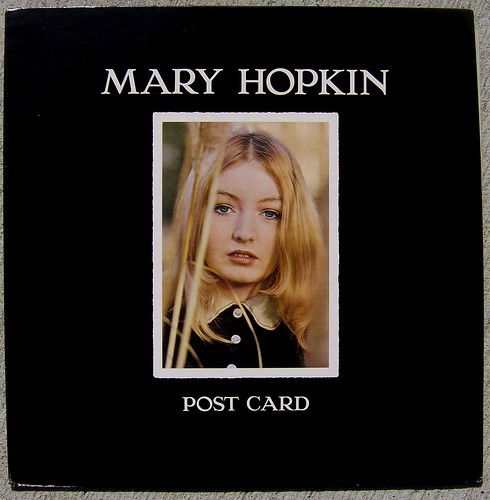
But my parents never stopped acquiring music (mostly records) for most of their 54 years (currently) together.By the time I was old enough to peer up at the shelves and shelves of records that spanned the walls of the living room in my parents’ house they had delved into nearly every modern genre, from the American song book to standards to jazz and vocals to country and folk and what I would spend a large part of my youthful days disparaging as “hippie shit” (Mary Hopkin, The Mamas and the Papas, Peter, Paul & Mary…).I even acquired my first Ken Nordine record out of my parent’s collection, but that’s another story.
Certainly my parents were too old to be inclined to follow post 1970 musical developments, and they were never Beatles, Led Zeppelin, nor post-1963 rock n roll people, so there was a cap on the breadth.But I’m not going to complain.Imagine thinking about trying to ingest that wall of music.What was it all supposed to mean?Who the heck was this Guy Lombardo guy?Who was Harry Belafonte?What does this mean, Handel’s Messiah?How is Handel’s messiah any different from that one they talk about in church?What are American Railroad Songs and why should I be interested in them?
It was also challenging that my brother, fourteen years my elder, became an avid record and music collector as well.Also not a fan of the acid-rock revolution he was born into, I owe him for a continual dosage of Johnny Cash, Hank Jr., and Gordon Lightfoot.
And my sister?Seven years my senior, my sister lived Martha Coolidge’s Valley Girl.I owe her for exposure to the birthing throes of KROQ, second wave ska, The Stray Cats, the resurrection of my mother’s dust gathering 45s, and a worn out Depeche Mode cassette.Then she graduated high school and dragged hip-hop into the sonic menagerie I encountered on a daily basis.
So I did what any good kid who was immersed in this veritable cornucopia of musical opportunity would do.I started listening to gangsta rap.
Actually, that’s not quite the truth.When I first determined that I would come into my musical own, I turned on the clock radio in my room that had never uttered a peep except to klaxon me into wakefulness in the morning.The one thing I found that was different from all the offerings in my home was classical music.I don’t even remember the station. It was somewhere way down on the left hand end of the dial.It may even have been AM for all I remember.But it was different, and in light of the rest of these music purveyors inhabiting my living space, it was mine.
So I listened to classical music. I didn’t know the composers.The complicated titles of the compositions meant nothing to me.No attention was paid to this orchestra or that orchestra or such and such a conductor.But that’s what was in the background of my homework and model-building and whatever else I accomplished in my room as an adolescent.I don’t know what my family thought of it.Perhaps they thought it was odd.Maybe my parents thought I would grow up to be “cultured” or something.I don’t know.I don’t recall anyone ever commenting on it.
Then, one day, one of my sister’s boyfriends gave me a copy of Sir Mix-a-Lot’s “Swass”.I apparently approved, because then he loaned me NWA’s “NWA and the Posse” and Ice T’s “Power”.Being the logical individual I am, I was of course curious about the Intro and Outro tracks of “Power”, so along came Ice T’s “Rhyme Pays”.
So then I listened to classical music and gangsta rap.
And that’s pretty much the way it went for me all through middle school and into high school.My headphones were pumping one of two things into my ears… something akin to Wagner’s “Ride of the Valkyries” or something like Eazy E’s “Eazy Duz It”.I don’t really have an answer for the appeal of gangsta rap as a genre to a middle class white kid from the San Fernando Valley.I certainly wasn’t much of a rebellious type.For whatever reason, it just clicked.Somewhere along there I also acquired an interest in film music, probably via the renditions of Wagner used in Boorman’s “Excalibur”, but ultimately it was probably because it reminded me of classical.
Then, in 10th grade (back then, high school started with 10th grade), someone pressed a cassette tape into my hands with instructions to listen carefully.This was an album called “Disintegration” by a band called The Cure.I vaguely remembered seeing a Cure shirt on a guy in middle school.But this guy was also a devoted Beatle-maniac and talked continually about GREASE (the musical).I didn’t know what to expect.But I listened to it.
To say that it put a speed bump on my classically gangsta rap highway would be sort of an understatement… but to say that I didn’t like it would be a lie.It intrigued me deeply, actually.I don’t know if I was aware of it at the time, but in looking back I can understand that there was enough of a musical connection between spoken word numbers like “Lullaby” and my rap/hip-hop leanings to create a stamp of approval.But atmospheric songs like “Untitled” were classical-ish and soundtrack-ish enough to also retain validity.In short, I realized I had a new musical strain to delve into.Several times I fell asleep and awoke to that album, the flip and reverse cycle on the walkman working overtime through the night.
Don’t let it be thought that at any time I despised or rejected the musical heritage my family imbued me with.I was always cool with whatever it was that my brother or sister or mom or dad was spinning (except maybe my dad’s propensity for Carly Simon and Carol King… I just never could abide by them).But, as most youth probably do, I was looking for something to call my own.What ended up happening, however, was I ended up with what seemed like a plethora of disparaging musical strains that didn’t seem to make sense together.
And so it went.The collecting of this and that into my musical interests until everyone thought I was just too strange in my musical leanings.My sister was fine with Tony Tone Toni, but wouldn’t return to the Depeche Mode she had dumped on me years prior.My brother was fine with Johnny Cash, but could I please turn off that Dead Can Dance stuff?Dad was fine with Tiny Tim, but Run DMC was not going to be okay… ever.
To further complicate matters, late one night I came across the late great Warren Kolodny’s “Stay Awake” program on KCRW.His guest DJ that fateful night was none other than Byron Werner, purveyor of all things Juan Garcia Esquivel and what he coined as “Space Age Bachelor Pad Music”.I was instantly enraptured by this complex, hard to pigeon-hole mid-century lounge music.Sure, my parents had the standard Ferrante & Teicher quotient and the smattering of the Rat Pack, but their collection did not dig as deep as Alvino Rey or Esquivel.I was caught up.
Much to the chagrin of those who associated with me, I was then on a rampage of mid-century instrumentalism.Orchestral lounge music, surf, and instrumental rock made certain that no one ever wanted to ride any distance with me in my car.Except my cousin Sean.Also an investigator of the odd and off-beat he seemed to get it.But we were in a lonely understanding.
But still there did not seem to be a thread of uniformity in my listening pleasures.I was resigned to the fact that I was just a musical weirdo… too eclectic for my own social good.Then one day a friend pushed a couple CDs into my hands.He said, “Here.Since all you’ll listen to is that guitar instrumental stuff, you will probably like this.”The CDs were a copy of The Cramps’ “Bad Music for Bad People” and a combo disc of their EP “Gravest Hits” and the seminal “Psychedelic Jungle”.I expect it was his hope to shake me back into some semblance of tolerability.
And it did shake me up.There was a dramatic affinity in me for The Cramps from the first time I spun those CDs.And it wasn’t necessarily that they were anything “new”, per se, but they were certainly “out of the ordinary”.I identified that punk-goth-weirdo rocker aesthetic instantly… but what really fascinated me was that, despite the fuzz and the grind and the ooze and the moan and groan and snarl, I recognized that music as crawling from the records on my parents’ wall.Those 45s and LPs of my mom and dad’s, as well as my brother, had been dragged through the tapes and radio of my sister’s and those of my own youth, and out had popped The Cramps.
In those recordings there was an identifiable but indescribable link between everything I had been indoctrinated with musically while growing up.It contained the delirium of psychedelia, the brute force of punk, the forlornness of country, the desperation of the Delta, the lyrical recital of hip-hop, the innocent double entendre of rock n roll, the atmospheric repetition of electronic and industrial, the misery of Gothicism, and the illumination of the cathode ray, all wrapped into one aggressively complex offering.Lux Interior and Ivy Rorschach had groped back into the American musical psyche that had been buried by Beatles-mania and dragged it, kicking and screaming, into the latter 20th century.They bathed it in the taboo and rubbed musical America’s face in the discarded and forgotten heritage.And while it might be words of blasphemy to some, it was not the original material of The Cramps that really shined for me.For me, it was the way they reinterpreted the material of yesteryear with their own indelible stamp that was truly a mark of mastery.So well did they do this, in fact, that it was a fair amount of time before I knew that they weren’t just creating 100% music in the spirit of Americana ground up in a garage rock in-sink-erator.I remember the first time I heard Ronnie Dawson’s original “Rockin’ Bones”, or Roy Orbison’s “Domino”, or Jack Scott’s “The Way I Walk”, and said, “Wait… that’s not a Cramps song??What?!?”
You see, The Cramps had a way of culling through the obscure and finding the overlooked yet valuable, feeding it through their own creative meat grinder, straining it through the post modern musical mentality, and unleashing it again upon an unwary and unsuspecting audience.It makes me sad when I think of all the Hasil Adkinses and the Charlie Featherses that I may not have encountered in my musical journey had it not been for the vigilance of Lux Interior and his musical cohorts preserving them for me.And yet, they preserved the legacy of American music in such a personal manner that it also revealed the interconnectedness between so many seemingly disparate musical stylings.“Yes,” The Cramps seemed to always imply with each ground out chord and soulful yowl, “it really is all just the blues.”Later on down the road, this implication that I learned from The Cramps seemed solidified by learning that such seemingly far ranging artists as Hank Williams, Martin Gore, Alan Wilder, and Jimi Hendrix collected and drew inspiration from blues, hot-jazz, folk, and old timey musics.But it was that introduction to The Cramps that I look back on and see as the moment that I realized it all made sense.
With the second anniversary of Lux Interior’s untimely death approaching (he gave up the ghost on February 4th, 2009), I find myself glad that I had the opportunity to see them perform twice in the twilight of their twenty-some-odd year career.Once at the 2004 Hootenanny and a second time at Sunset Junction in 2006.I remember they headlined the Sunset Junction show, the last act of the night to grace the main stage, and the LAPD shut down the event just before Lux had the opportunity to shed his pants.It was almost as if they had been waiting for the moment.Some people have no sense of theater.
The Cramps.I owe them the recognition of being the source of coherence amongst my varied and divers musical interests.And while I doubt I would ever be inclined to rub my family’s nose in them, I also thank The Cramps for focusing an appreciation in me for the many colored musical umbrella I grew up under.Most of all, though, I give them credit for teaching me to dig deeper under the musical surface than I may ever have been inclined to do on my own.
Thanks, Lux, for not letting the music die.
Thanks, Andy, for jamming those Cramps CDs into my hands all those years ago.


 ncle Jello" was the first painting of Nouar's that I ever saw in person.



 ayle’s Perks is located at 9028 Balboa Blvd,
 merican Recordings by Johnny Cash arrived in 1994, produced by Rick Rubin as the first release of his newly renamed record label.
 y doom was to be minorly eclectic.